
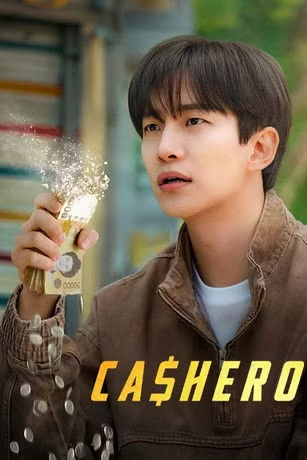
Drama: Cashero
Genre: Fantasy, Action, Comedy
Overall Rating: 🍜🍜 1/2
Summary
A broke civil servant inherits his father’s superpowers — but they only work if he has cash on him. Every heroic act costs money. He’s trying to save for an apartment, while a billionaire secret society wants to extract his powers for world domination. Of course.
Breakdown
Plot & Pacing: 🔵 🔵 🔵
Acting: 🔵 🔵 🔵 🔵
Characterization: 🔵 🔵
Tropes: 🔵 🔵 🔵
OST: 🔵
Watch if: Superpowers + short binge + low commitment sounds like a good time.
Skip if: You need logic, lore, and layered antagonists to stay engaged.
Review
📖 Plot & Pacing
The concept is genuinely interesting.
The main character, Kang Sang-ung, grew up poor on account of his father using his powers, spending whatever money the family had. Of course, Sang-ung doesn’t know this until he inherits the powers. He has just lived with a general resentment towards his father. Core trauma: dad stealing his piggy bank while bleeding and frantic. As an adult, Sang-ung is a civil servant with a basic salary. He is cautious with money and lets his girlfriend Min-suk run the numbers. She’s practical, blunt, and laser-focused on buying property.
Then Sang-ung inherits his powers and suddenly every punch directly impacts, food, rent, and of course, the savings plan.

In the background of all of this, there is a secret criminal society, run by a chaebol family, that has been rounding up these people with superpowers, paying them to, or sometimes forcibly extracting their powers.
The chaebol siblings, Joana and Jonathan, the show’s cartoonishly evil antagonists, target Sang-ung for his powers, hoping that the sibling who succeeds in obtaining them will not only control their father’s company but also the world.
But it is the plot of extracting powers from gifted people that leads to its collapse. The powers are a character in and of themselves, and how they are expressed is really interesting. Each power has a caveat. As we see with Sang-ung, he has to have cash on hand, and when he uses his power, he spends it. His teammates have issues, too. There is Bang Eun-mi, who has telekinesis, but she can use it only after consuming a certain number of calories. She is constantly eating, even when she doens’t want to. She eats high-calorie foods, which has her borderline diabetic. The other supporting character, Byeon Ho-in, can move through solid objects, but has to be pissy drunk in order to do so. He now has cancer of the liver, due to the amount of drinking he has to do to use his powers.

But when their powers are taken from them and injected into another person, there are no side effects! How Sway? No side effects. No trade-offs. No real costs. Some even double-dose powers like it’s vitamin C and walk away just fine. Maybe a little exhaustion, but that’s it.
So the entire thematic setup — power requires sacrifice — collapses. The metaphor is right there (inheritance, capitalism, exploitation), but the show never commits to it. The villains want “limitless power,” but why? To do what? The motivation is vague at best. Everything is surface-level.
Eight episodes weren’t enough. We needed more worldbuilding, more rules, more consequences.
Also: who hands someone $30,000 in a brown paper bag?
🎭 Acting
Despite the script being so so, the acting was well done. I am impressed with Kang Han-na as Joana and Lee Chae-min as Jonathan. Both were great villains, with devious, unscrupulous looks in their eyes and a smirk that conveyed satisfaction at bloodsport. Both played these villains well.

...great villains, with devious, unscrupulous looks in their eyes… do you see that look?
If Kim Byung-chul is in anything, I’m going to at least press play.
And as for Jun-ho, he was fine in the show. But perhaps because I watched Cashero and Typhood Family back-to-back, both roles feel like the same archetype: well-meaning man who fumbles forward while a strong woman handles logistics. I’d need to see him in something sharper to feel different.
🧠 Characterization
Serviceable. Not deep.
The villains lack backstory. Where is their mother? What actually drives them?
Sang-ung is said to be “bad with money,” but we don’t really see that. He’s not reckless. He’s just broke. Min-suk, on the other hand, is practical to the bone — and honestly, she’s the more grounded character.
There’s interesting psychological material here about inherited trauma and financial anxiety… but it stays surface level.
🔁 Tropes
Webtoon adaptation energy was strong.
The biggest trope: comically evil chaebols with zero nuance.
There’s also that fantasy-drug storyline K-dramas love lately — hyper-intense club scenes, wealthy sociopath dealers, mind-control drugs that turn people into monsters. You see shades of this in Strong Girl Nam-soon and The Fiery Priest (even though that one isn’t fantasy).
It’s exaggerated, yes. But given South Korea’s strict drug laws and recent spikes in trafficking cases, I get why it feels urgent in storytelling. Fantasy makes the moral panic easier to stage.
Still… subtlety would be nice.
🎶 OST
I couldn’t hum a single tune if I tried.
✨ Final Thoughts ✨
The show is fast, entertaining enough, and conceptually clever. The world-building doesn’t hold. The bones of the show are good, but it needed more time, nuance, and courage to actually say something.


